What Is the Enphase IQ Battery?
Enphase Energy is an American company founded in Petaluma, California, and best known for pioneering microinverter technology. Rather than one large central inverter handling all of a solar system's power conversion, Enphase attaches a small microinverter to each individual panel. The result is higher reliability, smarter monitoring, and better performance when any single panel is shaded or underperforming.
Enphase applied that same modular, microinverter-based intelligence to battery storage with the IQ Battery line. The current flagship, the Enphase IQ Battery 5P, is an AC-coupled unit, meaning it connects directly to your home's electrical system and works with virtually any existing solar setup. It uses lithium iron phosphate (LFP) chemistry, which is among the safest and most cycle-stable battery technologies available today.
All Propel Financing systems through Solar-Advisors.org include an Enphase IQ battery as part of the standard hardware package. It is financed alongside the solar panels and covered under Enphase's manufacturer warranty from the installation date.
Enphase IQ Battery 5P: Key Specifications
| Specification | Enphase IQ Battery 5P |
|---|---|
| Usable energy capacity | 5.0 kWh |
| Continuous power output | 3.84 kW |
| Peak power output | 7.68 kW |
| Round-trip efficiency (DC) | 96% |
| Round-trip efficiency (AC) | 90% |
| Battery chemistry | Lithium Iron Phosphate (LFP) |
| Rated cycles (at warranty threshold) | 4,000+ |
| Warranty term | 15 years |
| Warranted capacity retention | 70% at end of warranty |
| Coupling type | AC-coupled |
| Indoor/outdoor rated | Both (NEMA 3R rated) |
| Scalability | Up to 4 units per system phase |
How Long Does an Enphase IQ Battery Last?
The short answer is: longer than most homeowners expect. Battery lifespan is measured two ways: by calendar years and by charge cycles. Enphase covers both in their warranty, and both matter.
Calendar Life: 15 Years Warranted
Enphase warrants the IQ Battery 5P for 15 years from the date of installation. During that period, Enphase guarantees the battery will retain at least 70% of its original capacity. That means a 5.0 kWh battery will still store at least 3.5 kWh at the 15-year mark, under normal operating conditions.
In practice, many installations perform better than the warranty floor. Batteries in mild coastal climates, where temperatures are moderate and daily cycling demand is lower, tend to degrade more slowly than the warranted curve.
Cycle Life: 4,000+ Charge-Discharge Cycles
LFP chemistry is specifically chosen for its cycle stability. Each full charge-discharge counts as one cycle. At 4,000 rated cycles with daily use, that covers roughly 10 to 11 years of cycling. But most residential batteries do not cycle fully every single day. Partial cycles, days when the grid is not needed, and seasonal variation all extend the effective cycle count well beyond the mathematical minimum.
How Batteries Degrade Over Time
All lithium batteries lose capacity gradually over time. This is not a defect, it is physics. The degree and rate of degradation depends on several factors: heat exposure, depth of discharge, charge speed, and total cycle count. Enphase's LFP chemistry is specifically selected to minimize degradation compared to older lithium cobalt oxide (NMC) chemistries used in earlier battery products.
Here is a representative picture of how an Enphase IQ battery's usable capacity changes over time under normal residential use:
Capacity projections are representative estimates based on LFP degradation curves under moderate residential use. Actual results vary by climate, cycling frequency, and installation conditions.
What the Enphase Battery Warranty Actually Covers
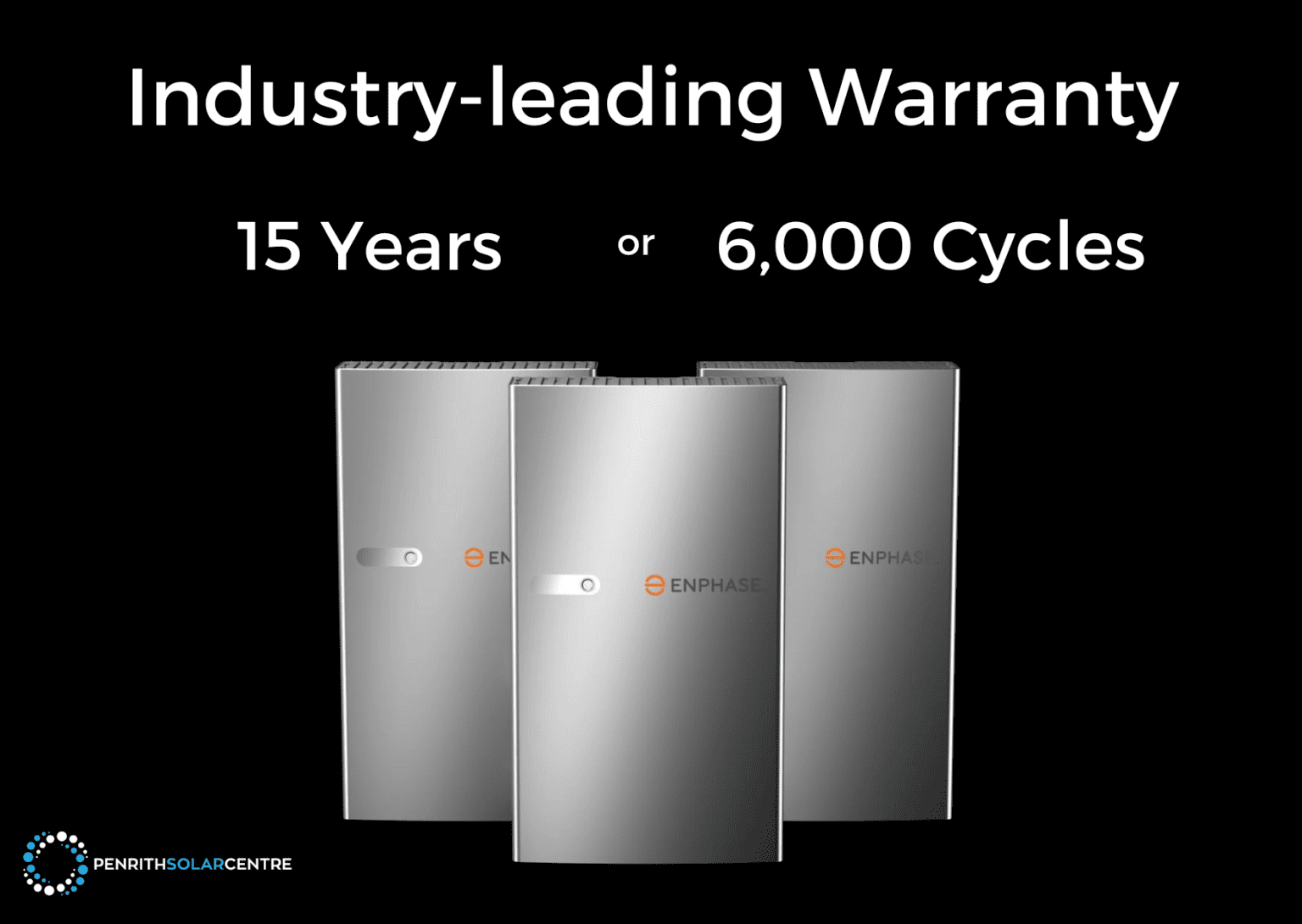
The Enphase IQ Battery 5P comes with a 15-year limited warranty that covers two things:
- Product defects in materials and workmanship, for the full 15-year term
- Capacity retention, guaranteeing at least 70% of original capacity remains at the end of year 15
What the warranty does not cover is equally worth knowing:
- Physical damage from improper installation, accidents, or environmental events
- Capacity loss due to use outside of Enphase's specified operating conditions
- Normal, gradual degradation that stays above the 70% threshold (that is expected, not a warranty event)
- Replacement costs if the battery degrades below 70% due to misuse
What Affects Battery Lifespan Most
1. Temperature
Heat is the primary accelerant of battery degradation. Enphase IQ batteries operate optimally between 32 and 113 degrees Fahrenheit and should be installed in shaded, ventilated locations. In hot inland climates, a battery mounted on an unshaded exterior wall in direct afternoon sun will degrade faster than one installed in a garage or on a north-facing wall. Coastal California homeowners often see extended battery performance because of the more temperate ambient climate.
2. Depth of Discharge
Regularly draining the battery to near-zero puts more stress on the cells than shallower cycling. In typical residential use, most homeowners are cycling from roughly 100% down to 20 to 30% before solar generation recharges the battery the next morning. That moderate depth of discharge is well within the parameters that support a long cycle life.
3. Charge Rate
Faster charging generates more heat, which accelerates degradation over time. Enphase manages charge rate automatically through its software and microinverter integration, which is one of the practical benefits of using a system designed as a complete Enphase ecosystem rather than mixing components from different manufacturers.
4. How Often You Cycle
Homes that draw heavily on battery storage every night cycle the battery more frequently than homes with modest electricity demand or those on time-of-use rates who only discharge during peak price windows. The cycle count clock ticks faster for high-use homes, but even daily full cycling at Enphase's rated 4,000 cycles covers well over a decade of operation.
What Happens After Year 15?
This is the question most battery discussions avoid. The honest answer is that the battery keeps working, just with less storage capacity. At the end of year 15, a well-maintained IQ Battery 5P retaining 70% of original capacity still stores 3.5 kWh usable energy. By year 20, many installations will be at roughly 60%, or about 3.0 kWh. That is still enough to cover overnight essentials for many households.
At that point, homeowners have three options:
- Continue using the existing battery. Reduced capacity but still functional. For lower-demand households, this may be perfectly adequate.
- Add a second battery. Enphase's modular architecture allows stacking up to four units per phase. Adding a new unit restores full or expanded storage capacity without replacing the original.
- Replace the battery. By year 15 to 20, battery technology and pricing will almost certainly have improved substantially. The replacement cost in 2040 will likely be lower in real terms than today's prices, with higher capacity per unit.
Notably, the solar panels themselves carry a 25-year product warranty and a 25-year performance warranty. The generation side of your system keeps producing well past the battery's warranty expiration. The battery is the component that may need attention first, but the overall system investment continues to pay off.
How Enphase Compares to Other Battery Options
The two most common battery technologies in residential solar today are NMC (nickel manganese cobalt) and LFP (lithium iron phosphate). Enphase's IQ batteries use LFP chemistry. Here is why that matters for lifespan:
- LFP is more thermally stable. Lower risk of thermal runaway, which means safer and longer-lasting in real-world conditions.
- LFP cycles better. LFP chemistry handles more charge-discharge cycles before degrading to the same threshold as NMC.
- LFP trades some energy density. LFP batteries are slightly bulkier per kWh than NMC alternatives, but for a stationary home installation that does not matter.
Tesla's Powerwall 3 also uses LFP chemistry. The primary differences between Enphase and Powerwall come down to integration architecture, monitoring, and installer network rather than chemistry.